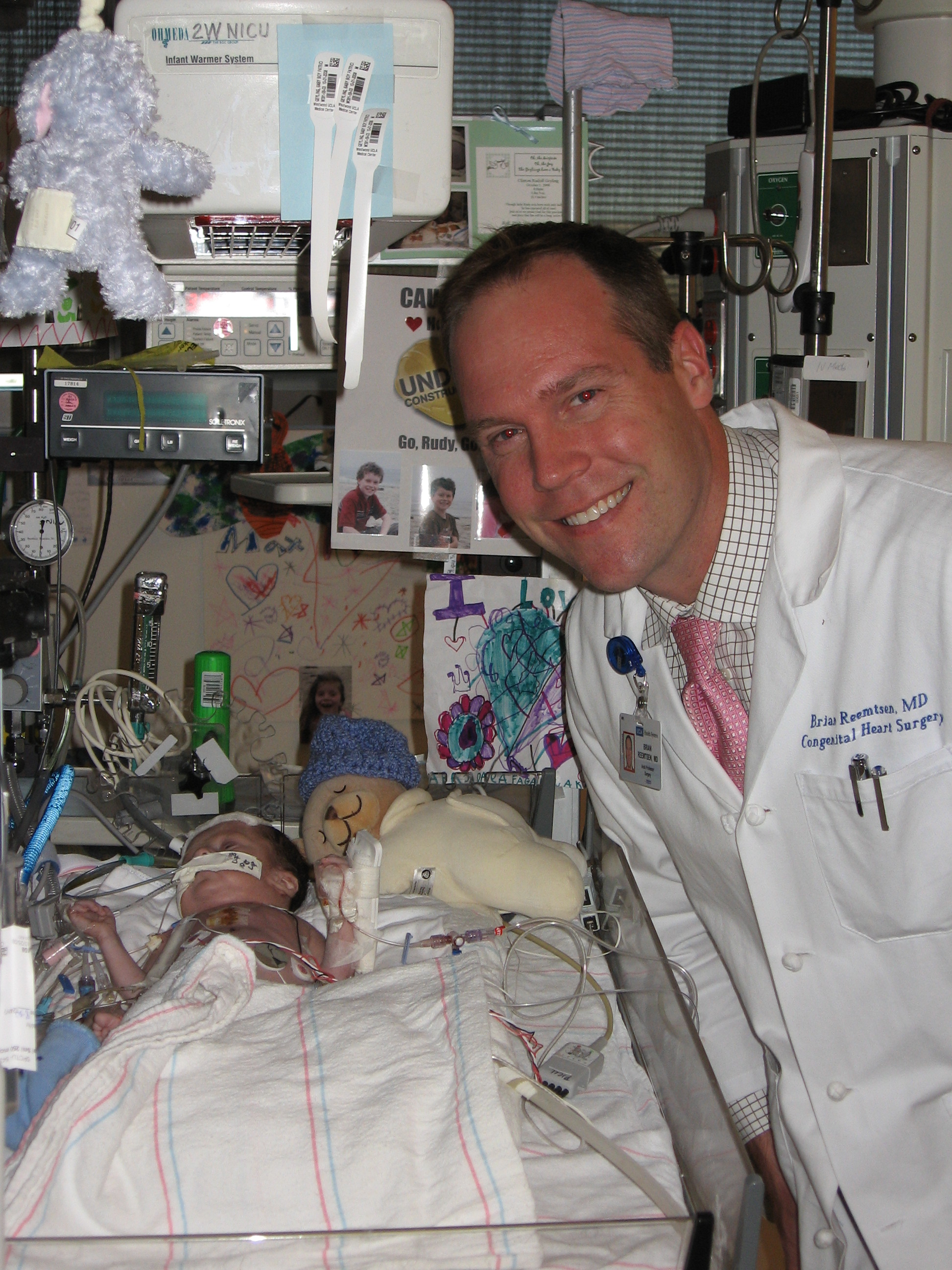
I’m usually not at a loss for words (as this blog would indicate), yet I’ve found it very hard to compose a tribute to the key member of Rudy’s team. There’s a tinge of pathos in saying that my son has the greatest heart surgeon in the world only because it assumes as a given that his condition demands it. I am sure no one here at UCLA would be offended by my saying that I would much rather Rudy have no need of any surgeon; but as that’s not our reality, it’s difficult to express the deep gratitude we have for Dr. Brian Reemtsen.
When we first learned of Rudy’s diagnosis of Hypoplastic Left Heart Syndrome we got several recommendations to seek treatment at Children’s Hospital Los Angeles (CHLA), but we discovered our insurance network was contracted with UCLA. While we were willing to fight to any extent necessary to get Rudy the right care we also realized the wisdom in reserving our energy for the most important battles, so we decided to do some due diligence and investigate UCLA—at least to have some grounds on which to base an appeal.
As I’ve already written, the initial responsiveness of Gary Satou and Dan Levi served as a remarkable introduction to the team at UCLA. Both spoke no ill of CHLA but also laid out what UCLA could offer—most importantly an expert surgeon, Dr. Brian Reemtsen, to do this very intricate surgery. Just months before, Dr. Reemtsen had come from CHLA to build a top-notch Pediatric Cardio-Thoracic Surgery program in the new Mattel Children’s Hospital at UCLA. They had high praise and said that they would speak with Dr. Reemtsen as he would certainly want to consult with us. This willingness was driven home the next day when Susan, his assistant, called to let me know that Drs. Satou and Levi had already spoken to Dr. Reemsten and he instructed her to call immediately to again affirm that he would make time to see us whenever we could get to LA.
Our first meeting with Dr. Reemtsen in September was no let down from the hopes we had built up. He took the time for a very thorough conversation, entertained any and every question and was straightforward about the challenging diagnosis we were confronting. He was empathetic, realistic and hopeful; able to put things into understandable terms and patiently allowed us to digest information and repeated himself if we asked.
We were forewarned of some the personalities we might encounter when dealing with specialists and surgeons who deal with such complicated diagnoses. We were warned that the greater the expertise, the more aloofness one might have to contend with. We were briefed on skilled surgeons who excel in the operating room, but might be less than comforting at bedside (on the rare occasions they make an appearance). I’m not sure what experiences fed these stereotypes, but meeting with Dr. Reemtsen quickly made it clear they didn’t apply here.
I spoke of the very strong recommendations we received for CHLA and Dr. Reemtsen took no offense at this, having nothing bad to say about his former employer and even encouraging us to investigate both options. In making the case for UCLA, he held forth the promise that he would be hands-on involved in Rudy’s care from delivery to discharge. His arrangement here is such that this is his only hospital and practice so he’s here every day and can remain very involved with his cases (contrasted to a specialized surgeon who might have patients in multiple hospitals and only pass through on an occasional basis). He would be by the bed several times a day and constantly interacting with the treatment team in every development and decision. He would be honest about our circumstances, communicate clearly and not give false hope.
It was a very encouraging conversation, at the end of which he pulled out his business card, wrote his e-mail address and cell phone number on the back, and made it clear that we should have no hang-ups about using it for any reason whatsoever. No answering service. No automated phone trees. Straight to him. I never ended up calling it but remember a few worried evenings in my office, as I tried to take in all the unknowns that lay before us, where simply picking up that card and turning it over to look at that number brought a sense of comfort and reassurance. We were in good hands.
At the outset, I don’t think I would have been able to articulate an itemized list of qualities I would want my son’s cardio-thoracic surgeon to have. As Rudy’s heart would be very small and would require very steady hands, I remember checking Dr. Reemtsen’s during that first meeting to make sure all the fingers were there and that they didn’t shake excessively. Overall, I noted no obvious involuntary ticks but did wonder if it would be possible for me to hide in his closet and jump out just to see that he didn’t startle uncontrollably. Other than that I didn’t have any sophisticated rubrics for evaluation. Other doctors spoke highly of him and we wouldn’t expect UCLA to hire anyone with blemishes on their record (but I did check), so the main criteria for us to choose our expert had little to do with an educated analysis of his skills, but simply by how we felt about him.
While arrogance is not an attractive trait, when it comes to choosing a heart surgeon neither is too much humility. You want self-confidence; a person who is well aware of their competencies and does not question them. While the general population strives for well-roundedness, I prefer my heart surgeon to be somewhat out of balance—a bit too dedicated to work, unable to thwart perfectionist drives, never able to make enough time for hobbies, incapable of leaving work on time or stay away on a weekend. Someone who will always remember that he’s dealing with MY baby—and that my world has come to a stop. Someone who realizes that my medical training ended with high school biology, but I’ll be comforted to know relevant information in language I can understand.
I trust the number of interactions with Dr. Reemtsen documented in this blog communicates implicitly what is taking me a number of passes to state explicitly. He is a person that exudes competence; who I suspect doesn’t give much time to things he can’t excel at. He is purposeful and doesn’t give indication that much time in his day gets wasted, but has time to stop and be friendly. He wears a mantel of importance, but carries himself without much fanfare. His attention to his patients knows few bounds as demonstrated by the evening and weekend visits and the late-night phone check-ins I’ve overheard.
If the guy who holds my son’s heart in his hands demanded I call him “Spartacus”, I’d have no problem doing it, yet I love the way he introduces himself as “Brian”. As isolating as life can be here in the CTICU addressing our key source of comfort as “Dr. Reemtsen” would keep him far more distant than we’d like.
I make no pretense that I’m motivated largely by my own self-interest in this whole journey. I want the best outcome. I want Rudy to have the best. But this comes at a cost, and I’d be delusional if I thought I was shouldering more than a fraction of this. In his devotion to our son, Brian has made our burden his (along with so many others here at UCLA) in ways that we never could repay. We’d like to think we know what’s best for our kids and provide everything for them, but this experience has shown our knowledge and competencies to be shockingly finite. So thank you, Brian, for having the expertise and skill we could never muster.
I also realize that others pay a cost for Brian’s round-the-clock devotion to Rudy. On several occasions, we’ve heard Brian speak of the Reemtsen ladies. As their husband’s and father’s commitment to my son undoubtedly makes for absences from them, we are so grateful. May they realize now and in the future the profound hope he brings to families like ours through what he does each day.
 Rudy's Beat